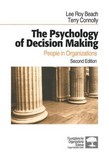
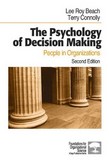
The Psychology of Decision Making provides an overview of decision making as it relates to management, organizational behaviour issues and research. The engaging book examines the way individuals make decisions; how they form judgments privately and in the context of the organization. It also discusses the interplay of group and institutional dynamics and their effects upon the decisions made within and on the behalf of organizations. Researchers and advanced students in the field of organization science, social, and industrial psychology who want a better understanding of how the field has developed as a scholarly discipline and of the processes involved in decision making will find this an excellent resource. The Second Edition has been entirely revised and updated to reflect recent research and changing perspectives. New to the Second Edition are; Latest developments in the field building on Prospect Theory; Current research on behavioural theory; Innovative suggestions by research scholars on subjects for new theoretical models
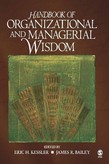
"A brilliant and comprehensive introduction to the most seminal component of leadership: wisdom. The diversity of the readings and wisdom of the authors make this a most original and valuable addition to the management canon." -Warren Bennis, Distinguished Professor of Management, University of Southern California and author of On Becoming a Leader "This wonderful compilation proves that management is as much art as science, and that deep thinking can inform and inspire practice to be more humane, ethical, and, yes, wise." -Rosabeth Moss Kanter, Harvard Business School Professor and best-selling author of Confidence: How Winning Streaks and Losing Streaks Begin and End "If you'll forgive a pun, this is a wise book about organizational and managerial wisdom. It shows what's possible when some of our best thinkers turn their collective attention to such timely subjects as EQ, negotiation, global politics, and individual and organizational ethics." -Steve Kerr, Chief Learning Officer, Goldman Sachs, and Past President of the Academy of Management "One of the 'most promising' forthcoming management books." -EUROPEAN ACADEMY OF MANAGEMENT "To wade into the topic wisdom is to see organizing differently. To wade into this volume is to see wisdom differently. Both forms of effort embody a wonderful moment of wisdom itself." -Karl E. Weick, Distinguished Professor of Organizational Behavior and Psychology,University of Michigan Some interesting issues emerge when one views organizations from a wisdom-based perspective. Does technology promote or inhibit wisdom? How do HR systems, organizational forms, management practices, and operational capabilities relate to wisdom? What are the ethical and social dimensions of wisdom? What makes a wise leader? Can wisdom be developed and utilized strategically? Do conceptions and manifestations of wisdom vary across cultures? Can one teach wisdom? Editors Eric Kessler and James Bailey have produced a ground-breaking compendium of globally renowned thinkers in the Handbook of Organizational and Managerial Wisdom. This Handbook systematically explores the characteristics of understanding, applying, and developing organizational and managerial wisdom. Key Features Organizes wisdom around the five primary philosophical branches-logic, ethics, aesthetics, epistemology, and metaphysics Applies wisdom in organizations and management through international examples that synthesize a set of practical principles for academics and practicing managers Offers an outstanding collection of world-renowned scholars who give profound insights regarding wisdom
The management of ambiguity is the theme of this landmark book, which brings new understanding to the co mplex processes of top managers'' decision making. '
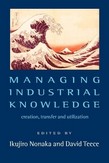
Managing Industrial Knowledge illuminates the complex processes at work in the creation and successful transfer of corporate knowledge. It is now generally recognized that the competitive advantages of firms depends on their ability to build, utilize and protect knowledge assets. In this volume many of the foremost international authors and ......
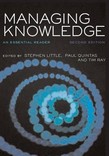
Knowledge management is crucial to organizational learning, innovation and success within organizations. The Second Edition of the successful knowledge management reader provides a core source of key theoretical thinkers in the field and presents the most up-to-date leading-edge articles that explore emerging trends. A comprehensive introduction places these readings in context and draws together key strands across the field. The new reader includes new and revised chapters as well as newly authored material, to provide students with a current resource that enables the study of knowledge management from a variety of perspectives. Theoretical work and engaging case studies place knowledge management in the context of an emerging global economy.
The Psychology of Decision Making provides an overview of decision making as it relates to management, organizational behaviour issues and research. The engaging book examines the way individuals make decisions; how they form judgments privately and in the context of the organization. It also discusses the interplay of group and institutional dynamics and their effects upon the decisions made within and on the behalf of organizations. Researchers and advanced students in the field of organization science, social, and industrial psychology who want a better understanding of how the field has developed as a scholarly discipline and of the processes involved in decision making will find this an excellent resource. The Second Edition has been entirely revised and updated to reflect recent research and changing perspectives. New to the Second Edition are; Latest developments in the field building on Prospect Theory; Current research on behavioural theory; Innovative suggestions by research scholars on subjects for new theoretical models
The management of ambiguity is the theme of this landmark book, which brings new understanding to the co mplex processes of top managers'' decision making. '
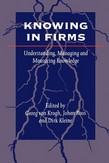
The first part of this volume links the concepts of organizational learning and trust with theories of knowledge, and uncovers the theoretical assumptions underlying the research of knowledge in organizations, and conceptualizes future research in the field. The second part presents practical approaches to managing, measuring and developing ......
This textbook provides an overview of the main strands, perspectives and debates in current thinking and practice in the area of employee involvement and participation. It adopts a comparative international approach, addressing developments in the UK and mainland Europe, the USA and elsewhere. The authors identify two main strands of evolution: one driven by managerial interests in enhancing and controlling employee commitment and performance; the other deriving from employees' attempts to influence high-level organizational decision-making. In particular, this study examines and analyzes: the background of key concepts, issues and philosophies underpinning these different strands; the range of current employee involvement methods, from the individualistic and management-led to more regulated collective approaches; and the rationales and responses of employees, unions and employers to the various initiatives.