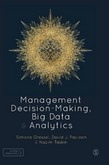
Accessible and concise, this exciting new textbook examines data analytics from a managerial and organizational perspective and looks at how they can help managers become more effective decision-makers. The book successfully combines theory with practical application, featuring case studies, examples and a 'critical incidents' feature that make these topics engaging and relevant for students of business and management. The book features chapters on cutting-edge topics, including: * Big data * Analytics * Managing emerging technologies and decision-making * Managing the ethics, security, privacy and legal aspects of data-driven decision-making The book is accompanied by an Instructor's Manual, PowerPoint slides and access to journal articles. Suitable for management students studying business analytics and decision-making at undergraduate, postgraduate and MBA levels.
The leading companies of the past twenty years have all harnessed the power of information to gain competitive advantage. But as access to big data becomes ubiquitous, it can no longer guarantee a leg up. Fast/Forward makes the case that we are entering a new era in which firms that understand the limits of 1s and 0s will take the lead. Whereas ......
"Libby and Detrick have compiled their extensive knowledge of the real issues that face our nonprofit sector to help students glean important lessons from each case. It is refreshing to have such a tool to assist in the education of our future nonprofit leaders." -Emma A. Powell, Western Michigan University Case Studies in Nonprofit Management by Pat Libby and Laura Deitrick consists of original cases that are designed to teach students how to think critically, hone their decision-making skills, and learn to apply leadership and management principles that are essential for any nonprofit professional. These case studies illustrate the multifaceted nature of the nonprofit management sector and bring concepts like nonprofit leadership, risk management, advocacy, and grant making to life.
Knowledge management is crucial to organizational learning, innovation and success within organizations. The Second Edition of the successful knowledge management reader provides a core source of key theoretical thinkers in the field and presents the most up-to-date leading-edge articles that explore emerging trends. A comprehensive introduction places these readings in context and draws together key strands across the field. The new reader includes new and revised chapters as well as newly authored material, to provide students with a current resource that enables the study of knowledge management from a variety of perspectives. Theoretical work and engaging case studies place knowledge management in the context of an emerging global economy.
Managing Industrial Knowledge illuminates the complex processes at work in the creation and successful transfer of corporate knowledge. It is now generally recognized that the competitive advantages of firms depends on their ability to build, utilize and protect knowledge assets. In this volume many of the foremost international authors and ......
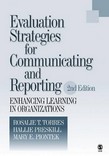
This comprehensive book is designed to help evaluators facilitate understanding, learning, and evaluation use among individuals, groups, and organizations by communicating and reporting more effectively. It guides the reader through the phases of an evaluation, from early planning stages through the final reporting and follow-up. It has been ......
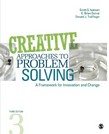
Creative Approaches to Problem Solving (CAPS) is a comprehensive text covering the well-known, cited, and used system for problem solving and creativity known as Creative Problem Solving (CPS). CPS is a flexible system used to help individuals and groups solve problems, manage change, and deliver innovation. It provides a framework, language, guidelines, and set of easy-to-use tools for understanding challenges, generating ideas and transforming promising ideas into action. Features and Benefits: - Specific objectives in each chapter for the reader - This provides a clear focus for instruction or independent learning - Practical case study introduced in the beginning of each chapter and then completed as a "rest of the story" toward the end of the chapter - This feature provides an application anchor for the reader - Upgraded mix of graphics - These updated and refreshed graphics include tables, figures, and illustrative images that are designed to provide "pictures" to go along with the word. The aim has been to aid attention, retention, and practical application - Enhanced emphasis on flexible, dynamic process- Enables users to select and apply CPS tools, components, and stages in a meaningful way that meets their actual needs - A framework for problem solving that has been tested and applied across ages, settings, and cultures- Readers can apply a common approach to process across many traditional "boundaries" that have limited effectives. Creative Approaches to Problem Solving has been (and continues to be) used as a core text for faculty who are teaching courses in Creative Problem Solving or Creativity and Innovation as part of an MBA program, or in Education, a course on Creativity (often as a component of certification or endorsement requirements in gifted education). It is also used as a core text for those enrolled in professional development, continuing education, or executive education programmes.
The notion that management knowledge is universal, culture-neutral, readily transferable to any country or situation, has come under mounting challenge. In this vein, this volume explores in detail the relations between management knowledge, power and practice in a world where globalization highlights, rather than obscures, the locally specific nature of many management recipes. This volume recognizes the political nature of management knowledge, as a discourse produced from, and reproducing, power processes within and between organizations. This theme underpins discussion of the ways in which management ideas and practices "produce" managers of a particular kind - "man of enterprise", bureaucrat, heroic leader. Critical examinations of certain current management theories - lean production, excellence, entrepreneurship - illuminate the myriad modes in which relations of power intermingle with relations of knowledge. Authors from a variety of different countries address the social and political processes involved in cross-cultural transference of management ideas across the world. They also look to the future, stressing the need for a substantial understanding that is less attuned to the corporate worlds of today and more appropriate for the increasingly diverse organizations likely to emerge in the 21st century.
The notion that management knowledge is universal, culture-neutral, readily transferable to any country or situation, has come under mounting challenge. In this vein, this volume explores in detail the relations between management knowledge, power and practice in a world where globalization highlights, rather than obscures, the locally specific nature of many management recipes. This volume recognizes the political nature of management knowledge, as a discourse produced from, and reproducing, power processes within and between organizations. This theme underpins discussion of the ways in which management ideas and practices "produce" managers of a particular kind - "man of enterprise", bureaucrat, heroic leader. Critical examinations of certain current management theories - lean production, excellence, entrepreneurship - illuminate the myriad modes in which relations of power intermingle with relations of knowledge. Authors from a variety of different countries address the social and political processes involved in cross-cultural transference of management ideas across the world. They also look to the future, stressing the need for a substantial understanding that is less attuned to the corporate worlds of today and more appropriate for the increasingly diverse organizations likely to emerge in the 21st century.