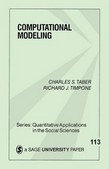
Computational modelling allows researchers to combine the rich detail of qualitative research with the rigour of quantitative and formal research, as well as to represent complex structures and processes within a theoretical model. After an introduction to modelling, the authors discuss the role of computational methods in the social sciences. They treat computational methods, including dynamic simulation, knowledge-based models and machine learning, as a single broad class of research tools and develop a framework for incorporating them within established traditions of social science research. They provide a concise description of each method and a variety of social science illustrations, including four detailed examples. Common to most of these methods is a straightforward underlying approach: develop a process theory, express this theory as a computer program, and simulate the theory by running the program. The book concludes with a discussion of ways to validate computational models.
This book is composed of eleven chapters, written by experts in their respective fields, on topics ranging from control of the Navier-Stokes equations to nondestructive evaluation - all of which are modeled by distributed parameters systems. Written by the plenary speakers for the Conference on Future Directions in Distributed Parameter Systems ......
Systems Thinking brings together classic and contemporary writings that cross the entire breadth of the systems field. The four-volume set includes the most influential theoretical papers, as well as applications in domains as diverse as global environmental modelling, business strategy, public sector planning, family therapy and the management of ......
In this book, Cees J Hamelink proposes an answer to - how should democratic societies organize cyberspace? - that puts human-rights, rather than profit, at the top of the agenda. He argues that conventional ethical approaches are all seriously flawed. There is a growing volume of moral rules, netiquettes and codes of conduct, but they are of ......
Linear Matrix Inequalities (LMIs) have emerged as useful tools for solving a number of control problems. This volume provides an account of LMI method and covers topics such as LMI algorithms, analysis and synthetic issues, nonconvex problems, and applications. It also emphasizes applications of the method to areas other than control. The basic ......
Mathematical Reviews said of this book that it was ""destined to become a classical reference"". It has appeared in Russian translation and has been praised both for its lively exposition and its fundamental contributions. The author first develops a general theory of nonsmooth analysis and geometry which, together with a set of associated ......