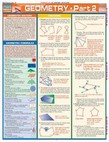
This 6-page laminated guide picks up where the Geometry Part 1 guide left off. It contains information on: geometric principles & formulas, polygon relationships, circles, trapezoids, parallelograms, rhombuses, central & inscribed angles, triangles & parallel line diagrams plus much more!
Olive Whicher's groundbreaking book presents an accessible - non-mathematician's - approach to projective geometry. Profusely illustrated, and written with fire and intuitive genius, this work will be of interest to anyone wishing to cultivate the power of inner visualization in a realm of structural beauty. Whicher explores the concepts of ......
This textbook offers a rigorous mathematical introduction to cellular automata (CA). Numerous colorful graphics illustrate the many intriguing phenomena, inviting undergraduates to step into the rich field of symbolic dynamics. Beginning with a brief history, the first half of the book establishes the mathematical foundations of cellular automata. ......
Among the many beautiful and nontrivial theorems in geometry found in Geometry Revisited are the theorems of Ceva, Menelaus, Pappus, Desargues, Pascal, and Brianchon. A nice proof is given of Morley's remarkable theorem on angle trisectors. The transformational point of view is emphasized: reflections, rotations, translations, similarities, ......
"One of Derrida's best."--Radical Philosophy. "Derrida's introduction is a detailed and illuminating study of Husserl and a model of excellence in the practice of phenomenology. Essential for the spe-cialist in phenomenology and for everyone interested in science, philosophy, and their interface...Highly recommended."--Choice "Derrida's ......
The Pythagorean Theorem is one of the best-known equations in mathematics. Its origins reach back to the beginnings of civilization. What most non-mathematicians don't understand or appreciate is why this simply stated theorem has fascinated countless generations. This book explores the history and importance of this remarkable equation.
The point, line, plane and solid objects represent the first three dimensions, but a kind of reversal of space is involved in the ascent to a fourth dimension. This book talks about this perspective, using words, diagrams, analogies and examples of many kinds.
We develop a unified theory of Eulerian spaces by combining the combinatorial theory of infinite, locally finite Eulerian graphs as introduced by Diestel and Kuehn with the topological theory of Eulerian continua defined as irreducible images of the circle, as proposed by Bula, Nikiel and Tymchatyn. First, we clarify the notion of an Eulerian ......
Alexandrov spaces are defined via axioms similar to those of the Euclid axioms but where certain equalities are replaced with inequalities. Depending on the signs of the inequalities, we obtain Alexandrov spaces with curvature bounded above (CBA) and curvature bounded below (CBB). Even though the definitions of the two classes of spaces are ......