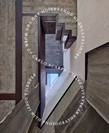
The work of Modernist architect Carlo Scarpa (1906-1978) is exemplary of an in-between practice, which is neither architecture nor conservation, but rather, architecture in conversion, dependent upon time, weather, and tempo. This book discusses the notion of architecture in conversion, revealing it to be radically different from current conservation practices, and to entail more than a change of use. Scarpas work represents a radical turn in how we see or understand something.
The significance of time, weather and tempo within Scarpas work, as well as the influences of artists such as Man Ray and Emilio Vedova and composer Luigi Nono, are revealed through a close analysis of Scarpas drawings and details from key buildings and their histories of multiple authorship. The book examines drawing as central to Scarpas practice: in lieu of creating physical models, his muti-directional drawings foreshadow the orbital movements of digital modeling techniques.
Based on discussions with many of his collaborators, the book highlights Scarpas collaborative approach, as well as the importance of all senses in his architecture. The book concludes by introducing the notion of unfinished architecture, and by discussing various contemporary architects projects which follow Scarpas approach to conversion of buildings.
Federica Goffiis a professor of architecture at the ASAU Carleton University, where she has taught since 2007. Goffi’s research concerns the renewal of buildings and questions the relationship between architecture and time. She authored Time Matter(s): Invention and Re-imagination in Built Conservation: The Unfinished Drawing and Building of St. Peter’s in the Vatican (Ashgate 2013).
Prakash Patel is an American architectural photographer and architect. His work has been published in architectural journals and design media worldwide.
Introduction: Architecture in Conversion. Part I: Time Sensing; Part II: Weather and Cyclical Architecture; Part III: Tempo and Allographic Architecture. The Plural Beginnings of Conversion. Bibliography. Index
Advocating transhistorical practices of conversion, an allographic architecture of becoming, and an imagination of multiple beginnings--as seen in the work of Carlo Scarpa and other practitioners--this rigorously researched and richly illustrated book invites us to rethink architecture, the profession, and education through the lens of adaptability. In an era of scarce resources and urgent sustainability challenges, Architecture in Conversion repositions conversion as a cultural practice in sharp contrast to the carte blanche ethos of orthodox Modernism. The book offers an invaluable resource for architects, historians, theorists, educators, students, heritage specialists, and built environment professionals, illuminating how buildings and sites are shaped through multi-authored interventions over time. - Sophia Psarra, Professor of Architecture and Spatial Design, University College London, The Bartlett School of Architecture
This book does not limit itself to describing Scarpas buildings, but presents insights based on first sources (buildings, original drawings and other archival materials) and interviews with Scarpas collaborators. In doing so, it explains the underlying reasons for his unusual practice, providing a more profound understanding of the meaning of the work. Illustrated with wonderful photographs by Prakash Patel, it does not give obvious answers, but formulates questions - exactly what every designer should continually do! - Valter Rossetto, Architect
Goffi offers a rigorous, innovative, and inspiring contribution to the fields of architecture in conversion, restoration, and adaptive reuse, linking them to the multifaceted concept of time. The work of Carlo Scarpa, which embodies restoration, historical layering, and architectural innovation, is tied by the author to modern and contemporary experiences. Scholarly and visually compelling, it is beautifully illustrated with photographs by Patel. - Alba Di Lieto, Politecnico di Milano; former Architect of the City Museums and Curator of the Carlo Scarpa Archive, Verona, Italy