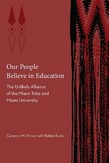
Across the United States, many institutions are striving to acknowledge and repair oppressive pasts and unequal presents, even as Indigenous communities are struggling to reclaim and revitalize the philosophies and knowledges of their elders. Our People Believe in Education explores the stories of the Miami Tribe of Oklahoma and Miami University to show how two organizations with almost nothing in common, aside from the name Miami, have collaborated to support Indigenous language and cultural revitalization. Founded in 1809, Miami University is a midsize public university in Oxford, Ohio, on land that once belonged to the Miami Tribe. The Miami Tribe of Oklahoma was, like many tribal nations, forcibly removed from its homelands and is now headquartered in northeast Oklahoma. Cameron M. Shriver and Bobbe Burke provide a reflective examination of why a relationship developed between the two entities despite significant geographical and ideological hurdles, and how that partnership has evolved since 1972, when Myaamia chief Forest Olds first visited Miami's university campus in his nation's homeland. This intimate history of a tribe and a university struggling to reconcile colonial education with Indigenous survival offers a jumping-off point for new conversations in, and between, these two spheres.
Cameron M. Shriver is a senior research associate at the Myaamia Center at Miami University. Bobbe Burke is the Miami tribe relations coordinator emerita at the Myaamia Center at Miami University.
List of Illustrations Authors' Note Foreword by Dustin Olds Introduction Part 1. Backgrounds 1. Founding 2. Educating for Empire 3. Myaamia Schools 4. Colonial Schooling 5. Creating a Brand Identity Part 2. Foregrounds 6. Origin Stories 7. Pursuing Education 8. Change the Name 9. Eemamwiciki 10. The Broom Closet 11. Tribe Class 12. Neepwaantiinki 13. Out of the Cocoon Epilogue Acknowledgments Note on the Literature Notes Bibliography Index
"As universities grapple with issues connected to slavery and the theft of Indigenous land, this example of a university and tribal nation developing a partnership and working toward aspects of restorative justice is very important."-Samantha M. Williams, author of Assimilation, Resilience, and Survival: A History of the Stewart Indian School, 1890-2020 "As a proud Native American (Ojibwe/Dakota) graduate of Miami University, I appreciate this book's willingness to take readers to where the truth usually resides: in the gray areas of ambivalence, cost-benefit analysis, and unintended consequences. Highly recommended."-Scott Richard Lyons, author of The World, the Text, and the Indian: Global Dimensions of Native American Literature